
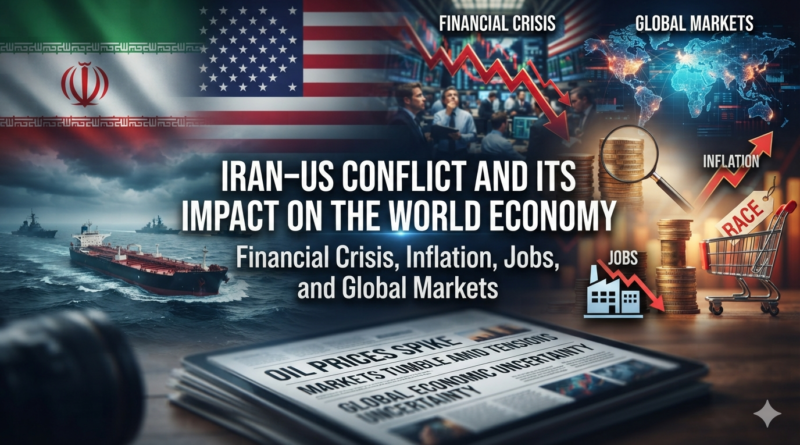
Iran–US Conflict and Its Impact on the World Economy: Financial Crisis, Inflation, Jobs, and Global Markets
Introduction
The conflict between Iran and the United States is more than a regional geopolitical dispute. It has become a major concern for governments, investors, businesses, and ordinary families around the world. Whenever tensions escalate in the Middle East, global financial markets react immediately because the region plays a crucial role in supplying the world’s energy.
International organizations, including the IMF, warn that prolonged conflict can reduce global economic growth, increase inflation, disrupt trade, and create uncertainty for businesses. While the world economy has shown resilience, continued escalation could produce far-reaching consequences that extend well beyond the Middle East. (IMF)
How the Iran–US Conflict Affects the Global Economy
The biggest economic risk comes from energy markets. Nearly one-fifth of global oil shipments pass through the Strait of Hormuz. Any disruption increases oil prices almost immediately, raising transportation, manufacturing, electricity, and food costs worldwide. (Investopedia)
Higher fuel costs force companies to spend more on production and logistics. Many businesses pass these costs on to consumers, creating inflation. Central banks often respond by keeping interest rates higher for longer, making mortgages, business loans, and consumer borrowing more expensive.
Financial Market Impact
Financial markets dislike uncertainty.
During periods of heightened conflict, investors often move money away from risky assets and into traditional safe havens such as gold and government bonds. Stock markets frequently experience increased volatility, airline stocks may decline because of higher fuel costs, and shipping companies face increased insurance expenses.
Banks also become more cautious when lending, reducing business investment and slowing economic activity.
Global Trade Disruptions
The conflict affects international trade through several channels:
| Sector | Possible Impact |
|---|---|
| Oil & Gas | Higher prices and supply uncertainty |
| Shipping | Increased insurance and transport costs |
| Airlines | Higher fuel expenses |
| Manufacturing | More expensive raw materials |
| Agriculture | Rising fertilizer and transportation costs |
| Retail | Higher consumer prices |
Inflation Around the World
When oil becomes more expensive, almost every industry experiences higher operating costs.
Consumers notice rising prices in:
- Food
- Electricity
- Public transport
- Air travel
- Imported goods
- Construction materials
The IMF recently reduced its 2026 global growth forecast to around 3%, citing renewed Iran-related tensions as one of the major risks affecting the global economy. (Moneycontrol)
Employment and Job Losses
There is no verified global estimate of how many jobs have been lost directly because of the Iran–US conflict. Current evidence does not support claiming a worldwide unemployment figure. (IMF)
However, economists expect employment pressure in industries such as:
- Tourism
- Aviation
- Shipping
- Manufacturing
- Energy-intensive industries
- International logistics
- Retail
If high inflation and slower economic growth continue, companies may reduce hiring, delay expansion, or implement layoffs.
Countries Most at Risk
Countries heavily dependent on imported energy generally face the greatest economic pressure.
These include:
- Pakistan
- India
- Bangladesh
- Sri Lanka
- Japan
- South Korea
- Many European countries
Oil-exporting countries may initially benefit from higher prices, although prolonged conflict can eventually reduce global demand and increase financial uncertainty.
Impact on Pakistan
Pakistan is especially vulnerable because it imports much of its fuel.
Potential consequences include:
- Higher petrol prices
- More expensive electricity
- Increased inflation
- Pressure on the Pakistani rupee
- Higher import costs
- Slower industrial production
These challenges can reduce household purchasing power and increase the cost of doing business.
IMF Outlook
According to recent IMF updates:
- Global growth is expected to remain around 3% in 2026.
- Inflation risks remain elevated.
- Energy prices continue to be a major source of uncertainty.
- Further escalation could significantly weaken global growth. (Moneycontrol)
Conclusion
The Iran–US conflict is not only a political and military issue—it is also an economic challenge with global consequences. Rising energy prices, inflation, financial market volatility, and trade disruptions can affect businesses and households worldwide. While there is no official count of worldwide job losses directly caused by the conflict, economists agree that prolonged instability increases the risk of slower growth, weaker investment, and reduced employment opportunities. The ultimate economic impact will depend on whether tensions ease or continue to escalate. (IMF)